Neoclassical vs. Classical Ballet: What Sets Them Apart
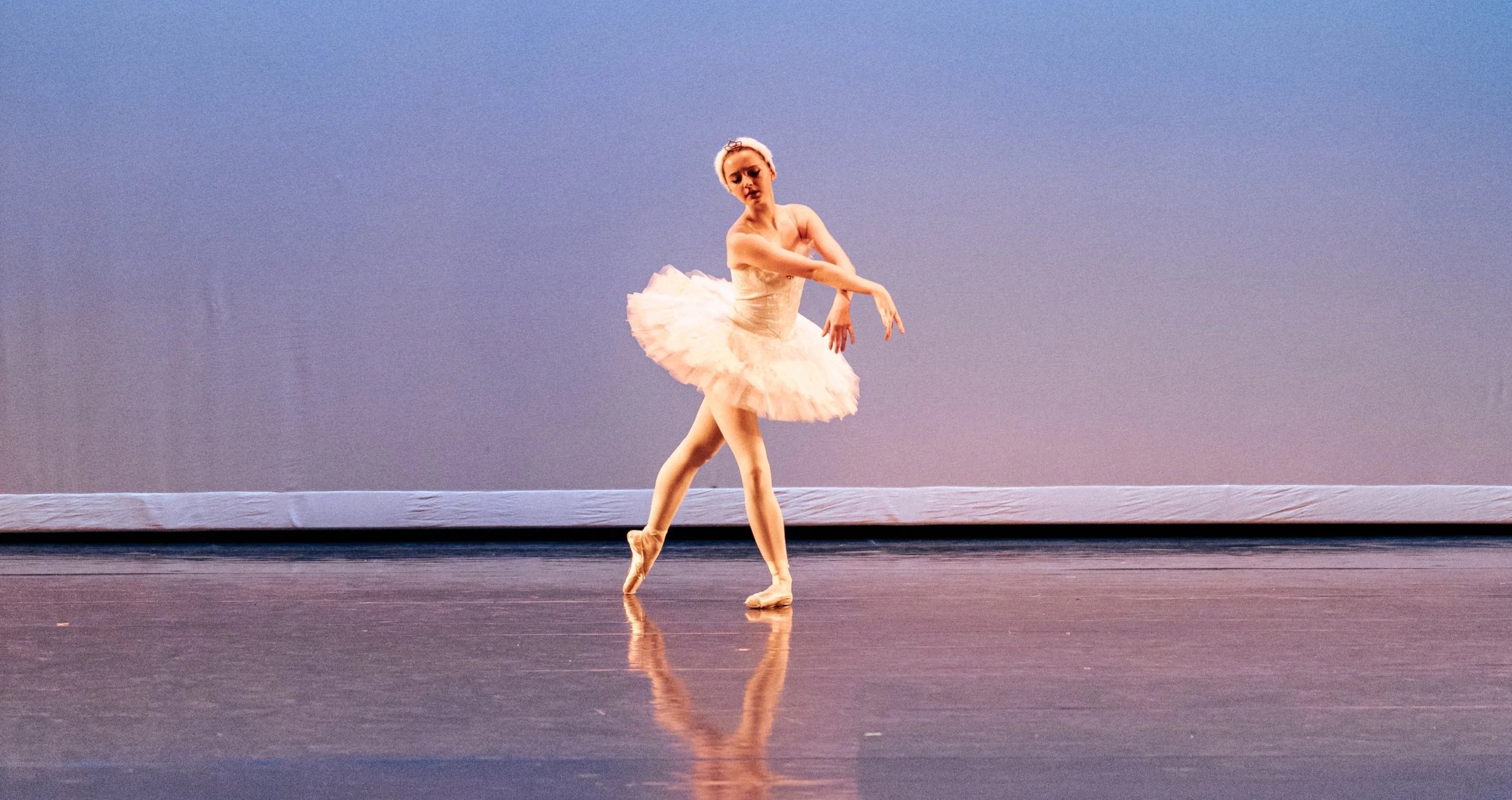
Swan Lake Variation from SCB’s 2025 All Academy Recital - West End to Broadway. Photo by Leah Michelle Photography
Key Takeaways
Foundation: Classical and neoclassical share the same core technique but differ by era: neoclassical grew out of classical through Balanchine in the 20th century.
Story: Classical is narrative-driven; neoclassical is often plotless, focused on movement and music.
Staging: Classical uses elaborate sets and ornate costumes (tutus); neoclassical strips down to minimal sets and simple attire.
Movement: Classical favors symmetry and flow; neoclassical brings speed, attack, and asymmetry.
Feel: Classical is grand and formal; neoclassical is sleek and stripped-down.
Legacy: Neoclassical reworked classical technique and paved the way for contemporary ballet.
Ballet has evolved dramatically since its origins in the royal courts of Renaissance Italy and France, and today the art form spans several distinct styles. Two of the most influential — classical ballet and neoclassical ballet — share the same technical roots but diverge sharply in look, feeling, and purpose. Understanding the difference makes watching a performance far more rewarding.
The Roots of Classical Ballet
Classical ballet is the most formal of the ballet styles. The history of classical ballet (and all ballet) began with the court dances of 16th-century Italy and, later, the French court of King Louis XIV, who founded the world's first ballet school and helped establish the vocabulary and technique still used today. Because the classical ballet era originated in France, ballet terminology remains in French worldwide.
Classical technique is built around the five basic positions, fluid arm movements, high extensions, and turned-out legs and feet, all performed with precision and formality. Structurally, classical ballets tend to follow a set format, typically staged in multiple acts built around a clear narrative. These are often drawn from fairy tales or mythology, such as “Swan Lake” or “The Sleeping Beauty.”
These productions are usually accompanied by elaborate sets and ornate costumes. Unlike the long calf-length tutus of the Romantic period, the classical ballet tutu pattern involves an above-the-knee cut to showcase the dancers’ legs. Classical ballet music typically involves grand orchestral scores, creating a theatrical experience meant to transport the audience into a fantastical world.
Because classical technique is relatively rigid and codified, it leaves little room for improvisation, though national schools such as the Russian, French, and Italian traditions each bring subtle stylistic variations to the same core vocabulary.
The Rise of Neoclassical Ballet
Neoclassical ballet history began in the early 20th century, largely through the work of Russian-trained choreographer George Balanchine, who brought ballet to the United States and co-founded New York City Ballet. Balanchine kept the technical foundation of classical training but pushed it further, emphasizing speed, attack, and more athletic, explosive movement. His style has been described as a unification of the traditional and the modern, retaining ballet's academic vocabulary while breaking away from its stricter conventions.
A defining feature of neoclassical work is what it strips away: elaborate sets, ornate costumes, and, often, a linear plot. Many neoclassical ballets are non-narrative, favoring choreography and music over storytelling.
Balanchine's ballets frequently used flexed hands and feet, turned-in legs, off-center or asymmetrical positions, and simple costuming — leotards and tunics rather than tutus — as a deliberate departure from classical and Romantic-era tradition. Works such as “Agon” and “The Four Temperaments” illustrate this shift, using abstract movement to explore relationships or emotional states rather than telling a story.
Comparing Structure, Story, and Look
The differences between the two styles show up clearly on stage:
Narrative: Classical ballet is generally story-driven, with acts and scenes structured around a plot. Neoclassical ballet is frequently plotless, often staged as a single act focused purely on movement and musicality.
Costume and set design: Classical productions favor elaborate sets and detailed, often period-specific costumes, including the stiff, short "platter" tutu. Neoclassical works tend toward pared-down aesthetics — minimal sets, simple lighting, and plain costuming — putting the focus squarely on the dancers' bodies and technique.
Movement quality: Classical choreography emphasizes symmetry, balance, and an ethereal, flowing quality. Neoclassical choreography introduces asymmetry, an off-balance feel, and noticeably faster, more powerful, and technically demanding sequences.
Overall mood: Attending a classical ballet production feels formal, similar to experiencing a night at the opera, while neoclassical ballet feels more like a casual theater experience with minimal trappings — the emphasis shifts from spectacle to the dance itself.
Why the Distinction Matters
Neoclassical ballet didn't reject classical technique — it reinterpreted it. Dancers in neoclassical works still rely on the same turnout, pointe work, and academic vocabulary developed centuries earlier. What changes is how that vocabulary is deployed and what surrounds it on stage. In that sense, neoclassical ballet acted as a bridge, later opening the door to the even more boundary-pushing contemporary ballet of choreographers such as William Forsythe and Crystal Pite.
For audiences, the easiest way to tell the two apart at a glance is to watch for story and spectacle versus abstraction and movement. If the ballet unfolds like a fairy tale with lavish sets and costumes, it's likely classical. If it feels sleek, fast, and stripped down, with little in the way of plot, it's probably neoclassical — a style built to let the dancing speak for itself.
Master the Best of All Ballet Styles With Southern California Ballet
Southern California Ballet is a world-class dance facility in San Diego that trains dancers for a professional career, empowers people for a life of success, and welcomes the community to be part of an extraordinary experience. Our mission is to empower aspiring dancers to reach their full potential and elevate the community through educational programs and imaginative performances.
Southern California Ballet’s training philosophy has been carefully honed by its artistic directors with the goal of providing effective, healthy, and foundational ballet training. We offer classes for people of all ages (four years old and up). Learn more about our classes and levels, and reach out to join our academy today!